

An assessment template gives you a ready structure for recording criteria, ratings and comments. Assessment is the process used by teachers and educators to measure and document the academic abilities, learning progress and needs or students in a particular academic institute. Assessment includes wide variety of methods and tools to get accurate results and outcomes. Assessment is considered as a vital part of teaching and learning process because it helps both student and teachers to determine whether or not academic goals and objectives are being met. Related templates: quiz templates, progress report templates, treatment plan templates and incident report templates.
What Is an Assessment?
An assessment is a structured way of gathering information to evaluate something, such as a student’s learning, an employee’s performance, a program’s results, a person’s needs or the risks of an activity. The goal is to make a fair, consistent judgment based on clear criteria and evidence. An assessment template provides the questions, criteria and rating scales in advance, so each assessment is carried out in the same way.
Usefulness of free assessment template
Perfect and timely assessment is productive for students and teachers because teachers can adjust their teaching strategies according to the learning needs or students and students can also adjust their learning strategies to chase chosen academic goals effectively. In this age of hard competition, assessment is considered as a vital tool to make performance of the academic institute better as well as to provide a friendly environment to students so they can learn more in short time while hunting academic objectives.
Most of academic institutes do assessment ahead of time to plan or modify teaching and learning course for individual students, groups of students or for the institute as whole. Assessment also enables students with required information and guidance so they can effectively plan and manage their needs and next steps to complete their academic courses or programs in timely manner. The sections below explain how to build an assessment template that makes assessment productive and meaningful.
Free Assessment Template Format
A free assessment template can be a printable form or a document you adapt in Word. You can edit the criteria, scoring scale and headings to suit your purpose, add your organization’s name and logo, and save a blank copy to reuse each time you carry out an assessment.
Types of Assessment Templates
- Student or classroom assessment: checks learning against objectives, using tests, rubrics or observation checklists.
- Self-assessment: lets students or employees reflect on their own skills and progress.
- Skills assessment: rates ability in specific tasks or competencies.
- Performance assessment: evaluates an employee’s work, goals and development needs.
- Needs assessment: identifies gaps between the current situation and what is needed, often used for training or community programs.
- Risk assessment: identifies hazards, who might be harmed and what controls are needed.
- Program assessment: reviews whether a course, project or service is meeting its goals.
Formative vs. Summative Assessment
In education, formative assessment happens during learning and helps teachers adjust their teaching, for example through quick quizzes, questioning or exit tickets. Summative assessment happens at the end of a unit or course to measure what has been learned, such as a final exam, project or portfolio. Many teachers use templates for both, with rubrics that make expectations clear to students.
What to Include in an Assessment Template
Most assessment forms share a common structure:
- Basic details: the person, team, activity or program being assessed, the assessor and the date.
- The purpose of the assessment.
- Clear criteria or questions linked to objectives or standards.
- A rating scale or scoring guide, with a short description of each level.
- Space for evidence, examples or observations.
- Strengths and areas for improvement.
- Actions, recommendations or next steps.
- Signatures or sign-off, where required.
How to Create and Use an Assessment
Begin by defining what you want to find out and why. Choose criteria that relate directly to that goal, and describe each rating level so different assessors would score the same work in a similar way. Test the template on one or two cases and refine any questions that are unclear.
When carrying out the assessment, record evidence as you go rather than relying on memory, and keep comments specific and constructive. Share the results with the people involved, agree on next steps, and keep the completed form so progress can be compared over time.
Using Rubrics and Rating Scales
A rubric is a table that lists each criterion down one side and describes performance levels across the top, such as beginning, developing, proficient and advanced. Clear descriptions for each level help assessors score consistently and show the person being assessed exactly what good work looks like. Simple numeric rating scales are quicker to complete, but they work best when each number has a short written description. Sharing the rubric before the assessment helps students and employees understand the expectations from the start.
Tips for Fair and Useful Assessments
- Keep criteria clear, relevant and measurable.
- Use the same template and scale for everyone being compared.
- Combine ratings with written comments to explain scores.
- Focus on behavior and results, not personal opinions.
- For workplace risk assessments, follow the health and safety requirements that apply to your organization.
Downloadable Assessment Templates And Formats
Below are free assessment templates in Word and Excel: an employee performance assessment, a student self-assessment, a risk assessment form, a skills assessment checklist and a training needs assessment. Download an assessment template, adjust the criteria and rating scale to your purpose, and save a blank copy to reuse.
Employee Performance Assessment Template (Word)
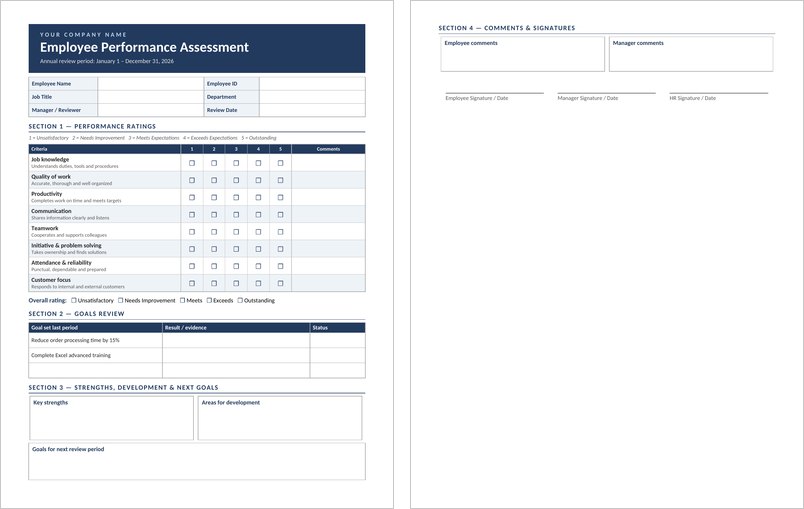
A complete employee performance review form with 1 to 5 rating checkboxes, overall rating, goals review, strengths and development areas, comments and three signature lines.

Student Self-Assessment Template (Word)
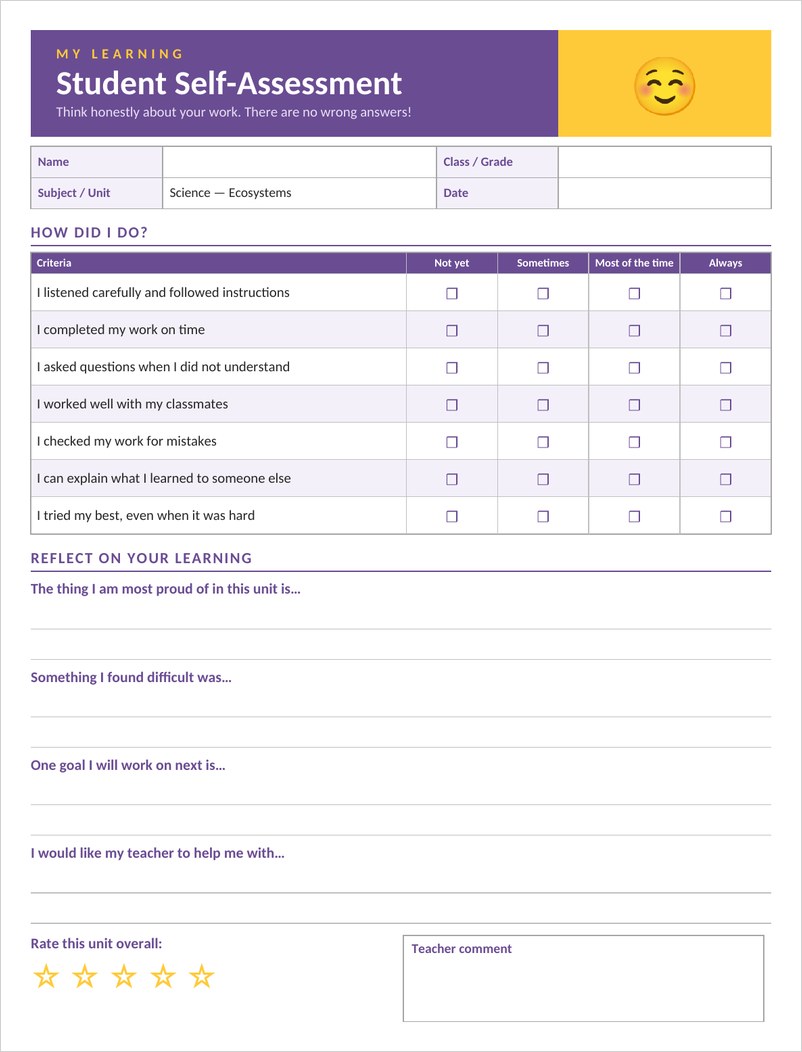
A kid-friendly student self-assessment sheet with simple rating checkboxes, reflection prompts, a star rating and space for teacher comments, for any subject or grade.
Risk Assessment Form Template (Word)
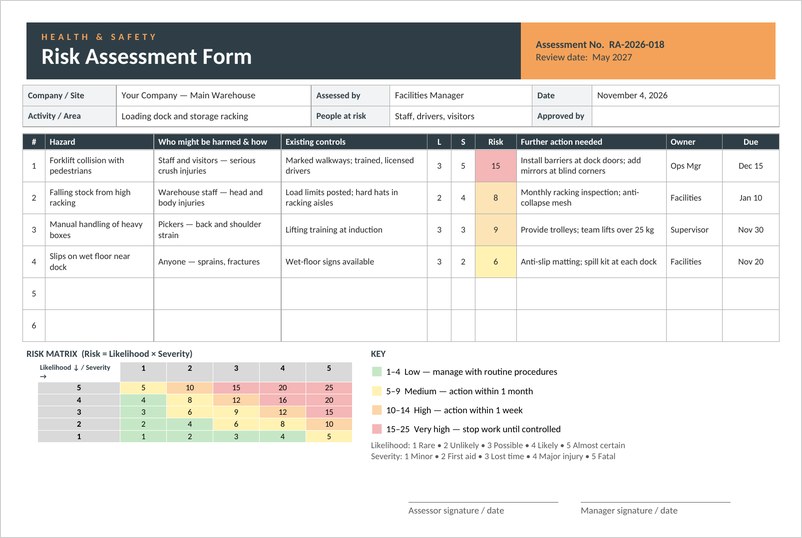
A landscape workplace risk assessment form with hazard table, likelihood and severity scores, further actions, color-coded 5×5 risk matrix and sign-off.
Skills Assessment Checklist (Excel)
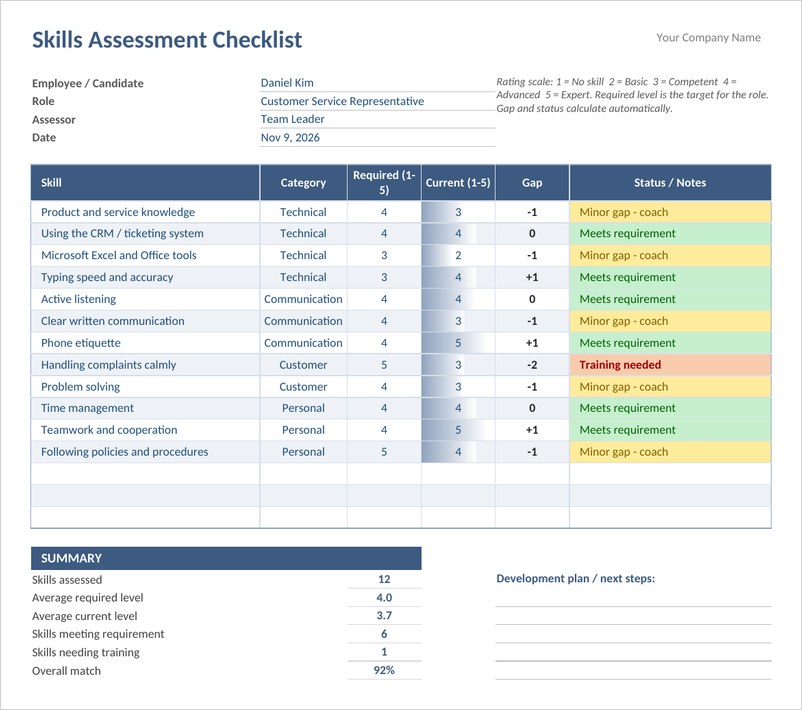
An Excel skills assessment that compares required and current skill levels, calculates each gap, flags training needs with color coding and summarizes the overall match.
Training Needs Assessment Template (Word)
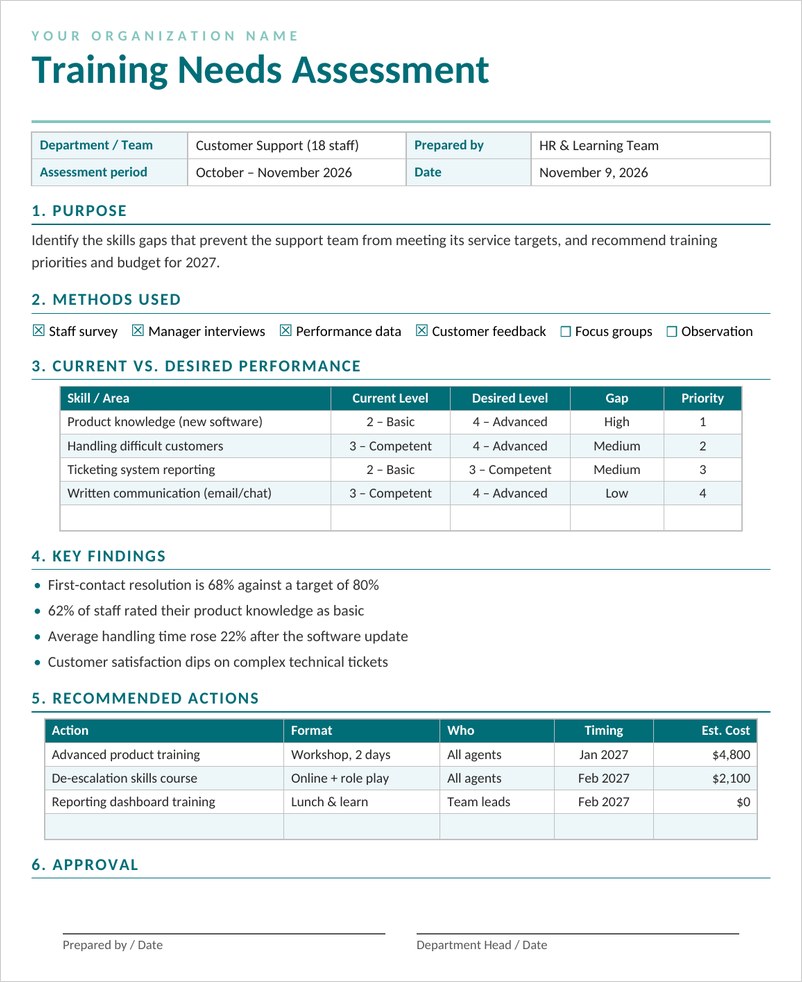
A training needs assessment report with purpose, methods, current versus desired skill levels, key findings, recommended actions with costs and approval signatures.
Frequently Asked Questions
What is an assessment template?
It is a ready-made form with criteria, questions and a rating scale that helps you evaluate learning, performance, needs, risks or programs consistently.
What is the difference between formative and summative assessment?
Formative assessment takes place during learning to guide teaching, while summative assessment measures learning at the end of a unit or course.
What should an assessment form include?
Include basic details, the purpose, clear criteria, a rating scale, space for evidence, strengths, areas for improvement and next steps.
Can I use one template for different types of assessment?
You can adapt a general template, but specialized assessments such as risk or performance reviews work best with criteria designed for that purpose.
How do I make assessments fair?
Use clear criteria and rating descriptions, apply the same template to everyone, record evidence and explain scores with comments.

You must be logged in to post a comment.