

A job description is a document that explains the purpose, responsibilities, duties, qualifications, and expectations associated with a particular position. A clear job description helps employers attract suitable candidates and gives applicants a better understanding of what the role involves before they apply.
A well-written job description template provides a structured format for creating consistent job postings and internal position documents. Instead of starting with a blank page, employers can use a template to organize important information such as the job title, department, reporting relationship, responsibilities, qualifications, required skills, working conditions, and other relevant details.
On this page, you can find 19+ free job description templates that can be customized for different positions and organizations. The templates are useful for businesses, HR departments, recruiters, managers, schools, nonprofits, and other organizations that need a professional way to define job roles.
What Is a Job Description?
A job description is a written explanation of a position within an organization. It describes what the employee is expected to do, the qualifications needed for the role, and how the position fits within the organization.
A job description can be used internally for hiring, employee onboarding, performance management, workforce planning, and role clarification. It can also provide the basic information needed to prepare a public job advertisement.
A typical job description may include:
- Job title
- Department
- Reports to
- Job location
- Employment type
- Position summary
- Key responsibilities
- Required qualifications
- Preferred qualifications
- Skills and competencies
- Experience requirements
- Working conditions
- Schedule or working hours
- Salary or compensation information, where appropriate
- Application instructions
The exact sections can vary depending on the position and organization.
Free Job Description Template
A free job description template gives employers a ready-made structure for documenting a position.
Instead of deciding how to organize the information from scratch, you can use a template and customize the sections according to the role.
For example, a company hiring an accountant may create a description containing:
Job Title: Staff Accountant
Department: Finance
Reports To: Finance Manager
Employment Type: Full-Time
Position Summary:
Responsible for maintaining financial records, preparing reports, reconciling accounts, and supporting routine accounting activities.
Key Responsibilities:
- Maintain financial records
- Reconcile bank and account balances
- Prepare financial reports
- Process invoices
- Assist with month-end closing
- Support the finance team
The same basic structure can be adapted for hundreds of different positions.
Job Description Template in Word
A job description Word template is useful for HR departments, recruiters, and managers who want an editable document.
Microsoft Word makes it easy to customize the job title, responsibilities, qualifications, company information, and other sections.
A Word template is especially useful when an organization wants to maintain a consistent format across multiple job roles.
For example, the same basic template could be adapted for:
- Accountant
- Sales Manager
- Marketing Executive
- Administrative Assistant
- HR Manager
- Customer Service Representative
- Project Manager
- Software Developer
- Teacher
- Office Manager
Job Description Template in Excel
An Excel job description template can be useful when an organization manages a large number of positions and wants to organize job information in a structured spreadsheet.
Excel can be used to maintain a job-description database containing fields such as:
| Job Title | Department | Reports To | Employment Type | Status |
|---|---|---|---|---|
| Accountant | Finance | Finance Manager | Full-Time | Open |
| Sales Executive | Sales | Sales Manager | Full-Time | Open |
| HR Assistant | Human Resources | HR Manager | Full-Time | Filled |
A spreadsheet can make it easier to sort, filter, and maintain multiple position records.
What Should a Job Description Include?
A good job description should provide enough information for a candidate or employee to understand the position without making the document unnecessarily complicated.
1. Job Title
Use a clear and recognizable title that accurately reflects the role.
For example:
- Marketing Manager
- Sales Representative
- Financial Analyst
- Administrative Assistant
- Operations Manager
Avoid unnecessarily creative titles if they could make the position difficult for candidates to understand or search for.
2. Position Summary
Provide a short explanation of the purpose of the role.
The summary should answer a basic question:
Why does this position exist?
3. Key Responsibilities
List the major duties the employee will perform.
Use specific action-oriented language such as:
- Prepare monthly reports
- Manage customer accounts
- Coordinate team meetings
- Maintain financial records
- Develop marketing campaigns
- Monitor project schedules
4. Required Qualifications
Explain the qualifications that are genuinely necessary for the position.
These may include:
- Education
- Professional certifications
- Technical knowledge
- Work experience
- Industry experience
5. Required Skills
List the skills needed to perform the job successfully.
Depending on the role, these could include communication, organization, analytical thinking, leadership, software knowledge, customer service, or technical skills.
6. Preferred Qualifications
If appropriate, distinguish desirable qualifications from requirements that are genuinely necessary.
This can help prevent a job description from becoming unnecessarily restrictive.
7. Reporting Relationship
Identify who the employee reports to and, where relevant, whether the position supervises other employees.
8. Work Location
Specify whether the position is:
- On-site
- Remote
- Hybrid
- Field-based
You can also include the city or office location when appropriate.
9. Employment Type
Clearly identify whether the position is:
- Full-time
- Part-time
- Temporary
- Contract
- Seasonal
- Internship
Job Description vs. Job Posting
A job description and job posting are related but aren’t always identical.
A job description is generally a detailed document explaining the position, responsibilities, qualifications, and expectations.
A job posting is the public-facing advertisement used to attract applicants.
A company may use a detailed internal job description as the source for creating a shorter and more engaging job advertisement.
For example:
Job Description: Detailed responsibilities, qualifications, reporting structure, and expectations.
Job Posting: Candidate-focused advertisement containing the most important role information, benefits, location, and application instructions.
Why Use a Job Description Template?
A reusable template offers several practical advantages.
Saves Time
HR professionals don’t have to design every job description from scratch.
Improves Consistency
Different departments can use a common structure.
Clarifies Responsibilities
Employees and candidates can understand what the position involves.
Supports Recruitment
A clear description can help attract candidates whose skills and experience match the role.
Helps With Onboarding
The document can provide a useful reference when a new employee starts.
Supports Performance Management
Clearly defined responsibilities can provide a foundation for discussing performance expectations.
Job Description for Employees
A job description isn’t only useful before someone is hired.
It can also help existing employees understand:
- Their primary responsibilities
- Who they report to
- What skills are expected
- Which activities fall within their role
- How their position fits into the organization
When responsibilities change substantially, the job description should be reviewed and updated.
Job Description for Hiring
A good job description for hiring should focus on the information candidates need to determine whether the position is appropriate for them.
Instead of listing every minor task, prioritize the responsibilities that are essential to the role.
A strong hiring description should make it easy to understand:
What is the job?
What will I do?
What qualifications do I need?
Who will I work with?
Where will I work?
What type of employment is being offered?
How do I apply?
How to Write a Job Description
Creating a job description doesn’t have to be complicated.
Step 1: Identify the Position
Start with the official job title and department.
Step 2: Define the Purpose
Write a short summary explaining why the position exists.
Step 3: List Key Responsibilities
Identify the most important duties rather than every minor activity.
Step 4: Determine Required Qualifications
Separate genuine requirements from preferred qualifications.
Step 5: Add Skills and Experience
Specify the knowledge, skills, and experience necessary for successful performance.
Step 6: Define Reporting Structure
Identify the manager or supervisor and any direct reports.
Step 7: Add Work Details
Include location, employment type, schedule, and remote or hybrid information where appropriate.
Step 8: Review for Clarity
Remove unnecessary jargon and make sure the requirements accurately reflect the actual position.
Step 9: Check for Bias
Review the language to make sure unnecessary or discriminatory requirements have not been included.
Step 10: Update Regularly
Review the job description when responsibilities, reporting relationships, or organizational needs change.
Job Description Examples
A job description example can help employers understand how different sections can be organized.
For example, a customer service representative description might include:
Position Summary:
Provide customer support through phone, email, and other approved communication channels.
Responsibilities:
- Respond to customer inquiries
- Resolve routine complaints
- Record customer interactions
- Follow company procedures
- Escalate complex issues
- Maintain accurate customer information
Required Skills:
- Strong communication skills
- Customer service experience
- Problem-solving ability
- Basic computer skills
The example can then be customized according to the actual position.
Job Description for Managers
A manager job description generally contains additional responsibilities related to leadership and supervision.
These may include:
- Managing employees
- Setting team objectives
- Reviewing performance
- Allocating resources
- Monitoring budgets
- Making operational decisions
- Reporting results to senior management
The description should distinguish managerial responsibilities from general employee duties.
Job Description for Remote Jobs
Remote positions benefit from clear descriptions because candidates need to understand how the role will operate outside a traditional office.
A remote job description can clarify:
- Remote or hybrid status
- Required working hours
- Time-zone expectations
- Communication tools
- Travel requirements
- Equipment expectations
- Collaboration requirements
Clear information can reduce misunderstandings during recruitment.
Job Description Template for Small Business
Small businesses may not have a dedicated HR department, making a reusable job description template particularly useful.
A simple template can provide a consistent format for documenting every position as the business grows.
Small businesses can use job descriptions for:
- Hiring
- Employee onboarding
- Role clarification
- Delegating responsibilities
- Performance discussions
- Organizational planning
Tips for Writing Better Job Descriptions
Use Clear Language
Write for the candidate rather than filling the document with unnecessary corporate jargon.
Focus on Outcomes
Where possible, explain what the employee is expected to accomplish.
Prioritize Responsibilities
Put the most important responsibilities first.
Avoid Unrealistic Requirements
Only include qualifications that are genuinely necessary or clearly distinguish preferred qualifications.
Keep It Updated
An outdated job description can attract candidates for a role that no longer reflects the organization’s actual needs.
Use Consistent Formatting
A consistent structure makes job descriptions easier to review and compare.
Download Free Job Description Templates
Whether you need a job description template, job description Word template, employee job description, job posting template, job description example, manager job description, or hiring template, the collection on this page provides a useful starting point.
Choose a format that matches your needs, customize the job title and responsibilities, and add the qualifications and organizational information relevant to the position.
A well-written job description can make the hiring process clearer for both employers and candidates while providing a useful reference after the employee joins the organization.
Downloadable Job Description Templates And Formats
This job description template provides a structured format for documenting a position’s responsibilities, qualifications, skills, and employment information. It can be customized for different roles within a company or organization.
The template can serve as a starting point for HR departments, recruiters, managers, and small businesses that want to create consistent job descriptions for their employees and open positions.
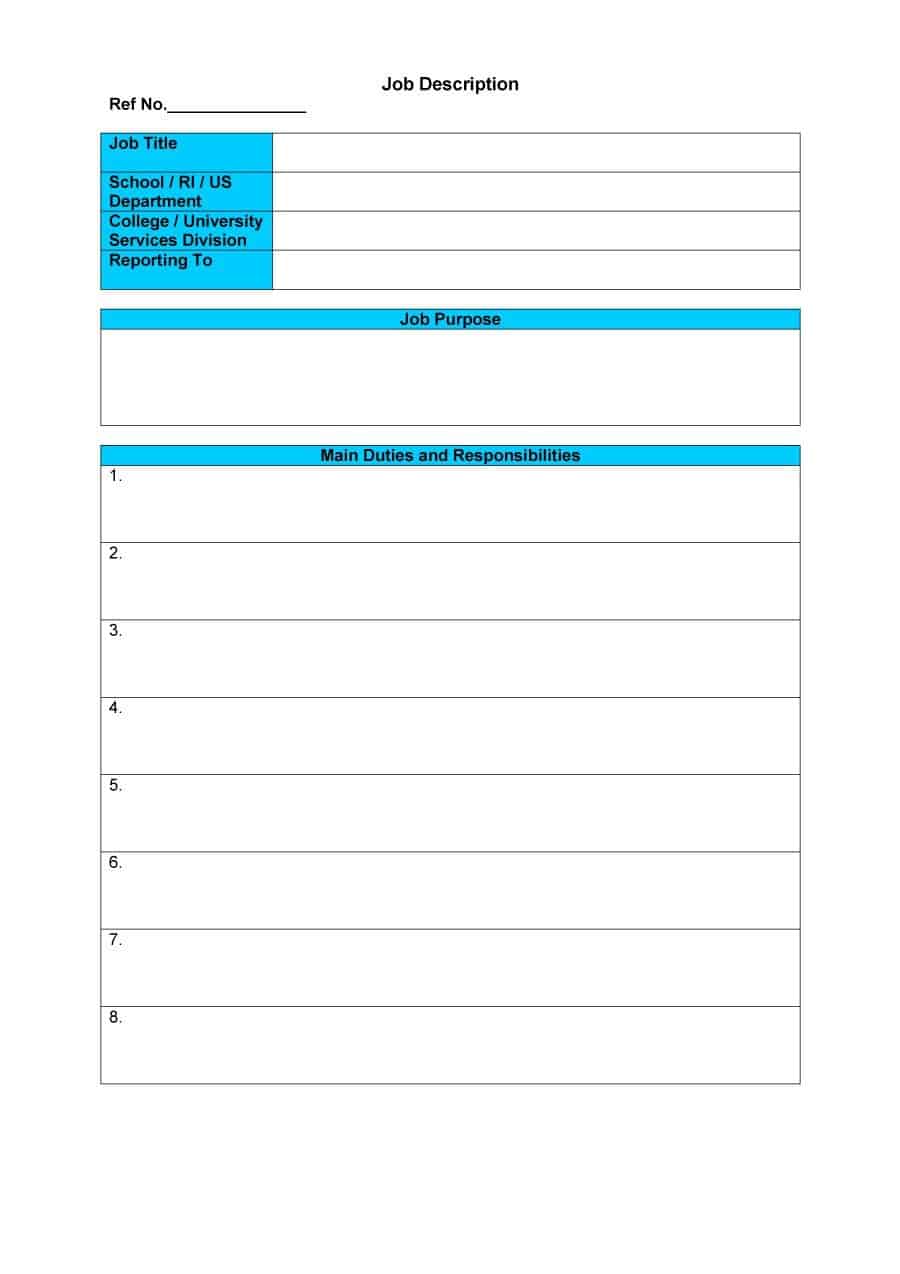

This example demonstrates how information for a particular position can be organized into a job description document. It can help employers understand the types of information that should be included when defining a role.
It can be customized for different departments and positions by replacing the example job title, duties, qualifications, and other information.
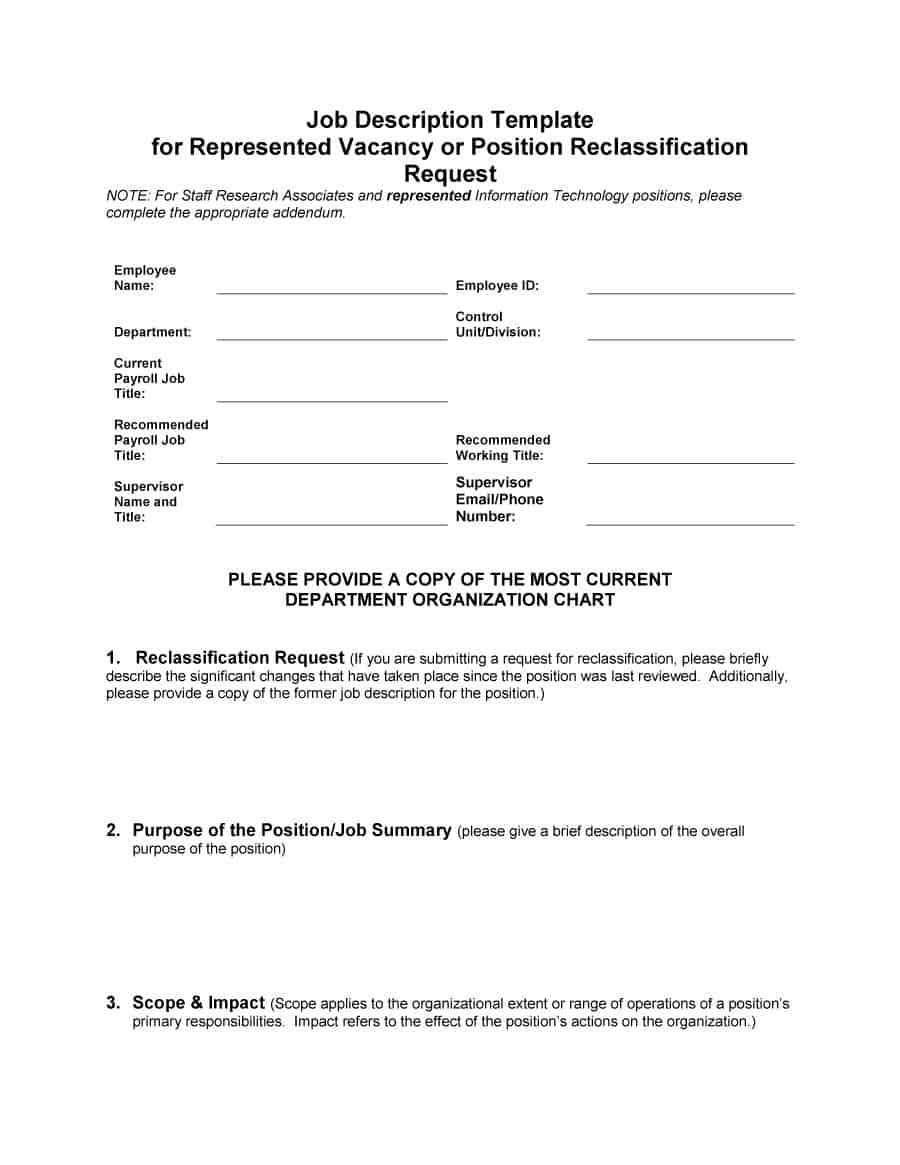
This sample provides a reference format for preparing a professional job description. It can be used to understand how position information, responsibilities, qualifications, and expectations can be presented.
Employers can adapt the structure for their own roles while ensuring that all requirements accurately reflect the actual position.
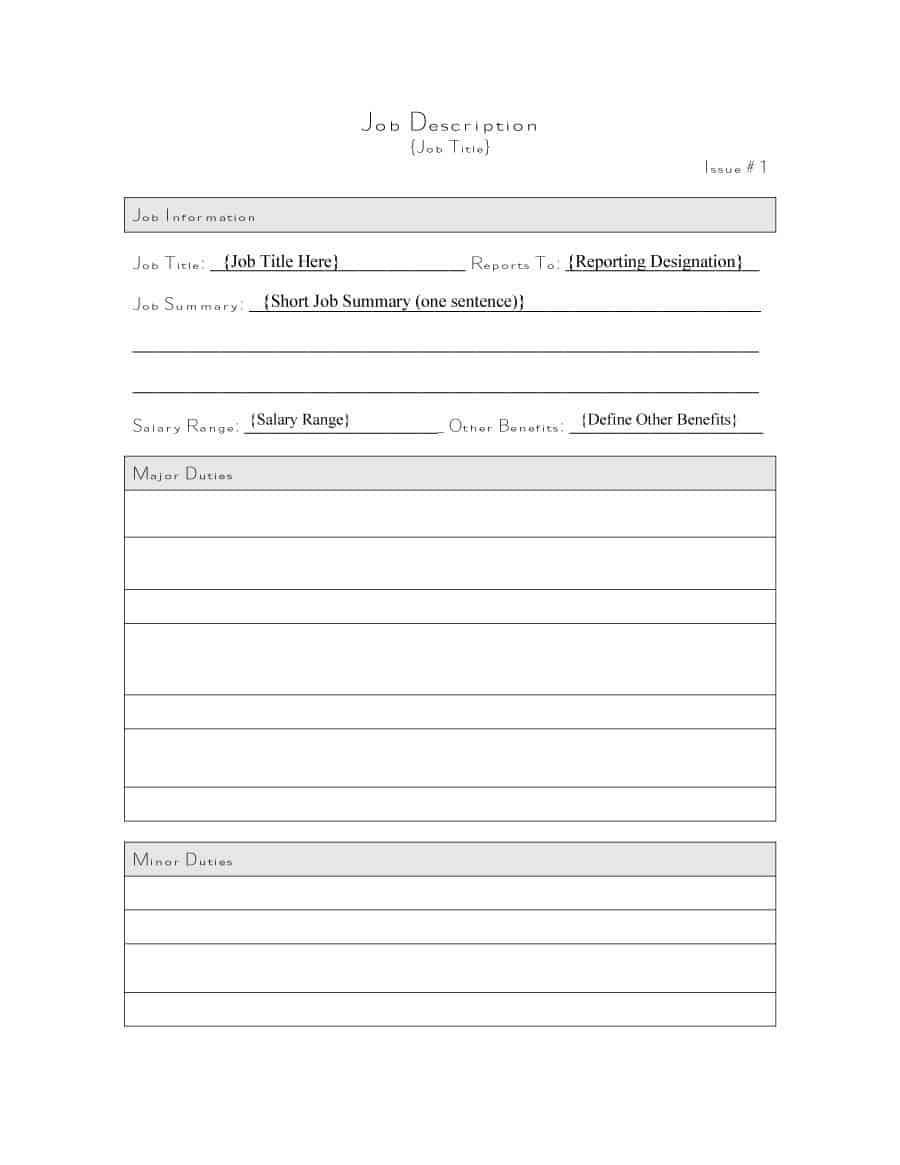
This template provides a format for documenting the responsibilities and expectations associated with an employee’s position.
It can be used for recruitment, onboarding, role clarification, and internal HR records, with the content customized for the specific job.
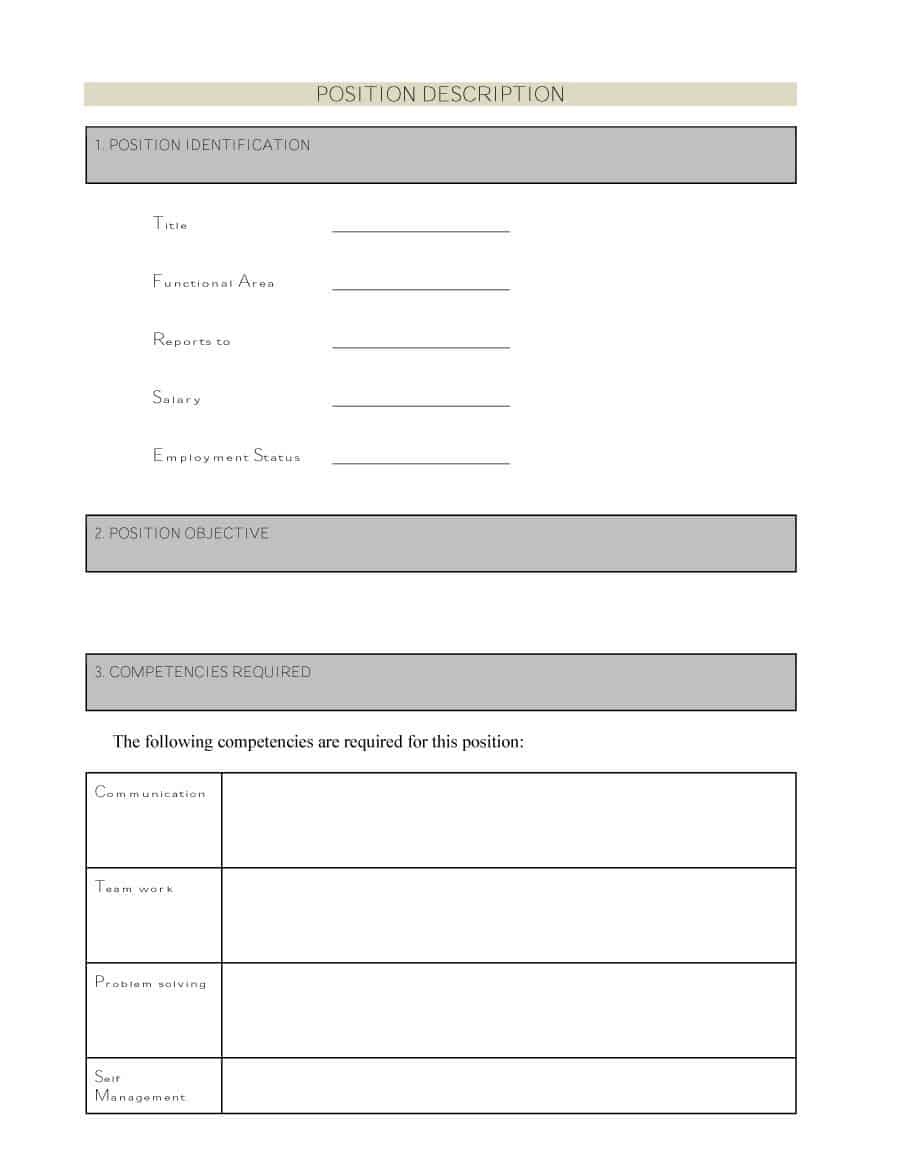
This template provides a structured format for organizing information about a position. It can be adapted with the job title, department, reporting relationship, responsibilities, qualifications, and required skills.
A consistent format can make job descriptions easier for candidates, managers, and HR teams to review.
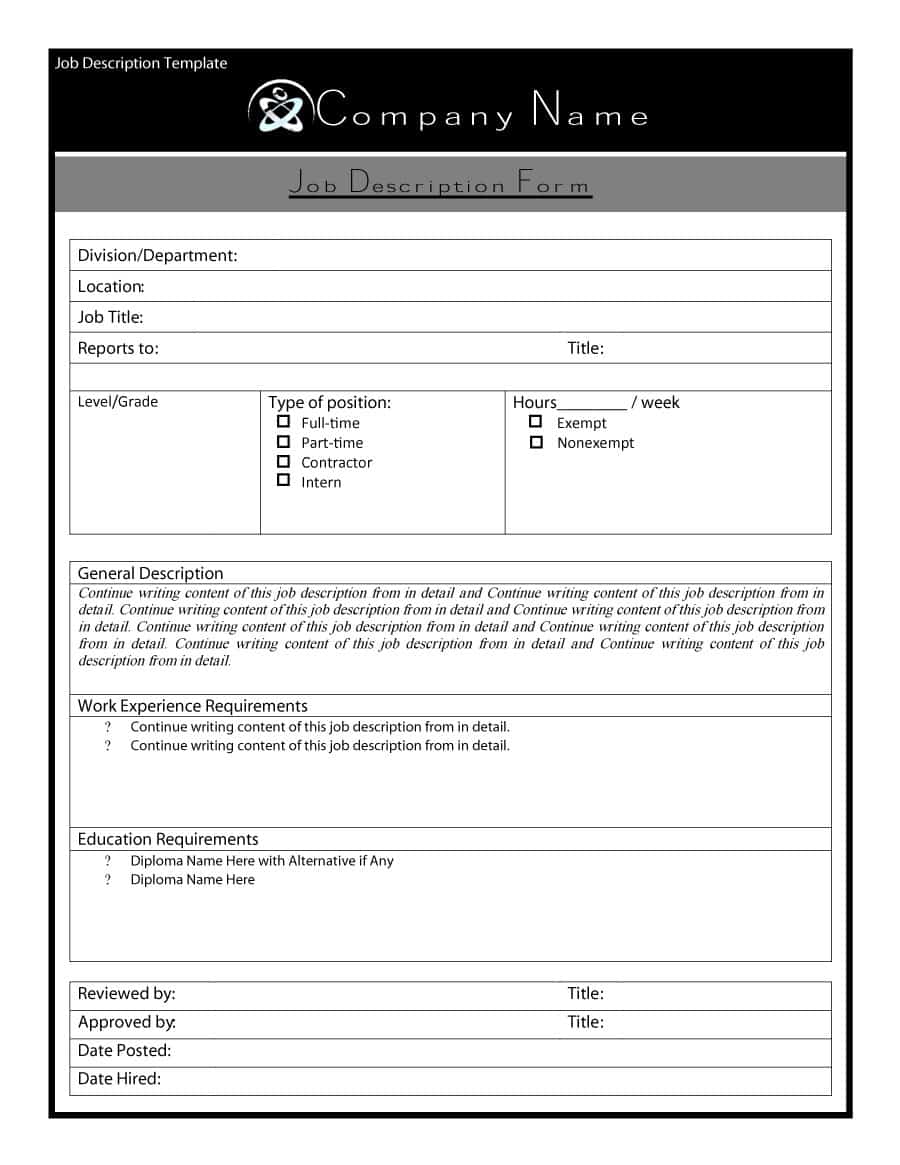
This editable template provides a starting point for creating customized job descriptions. Users can modify the job title, responsibilities, qualifications, and other fields according to the position.
It can be reused across different departments while maintaining a consistent organizational format.
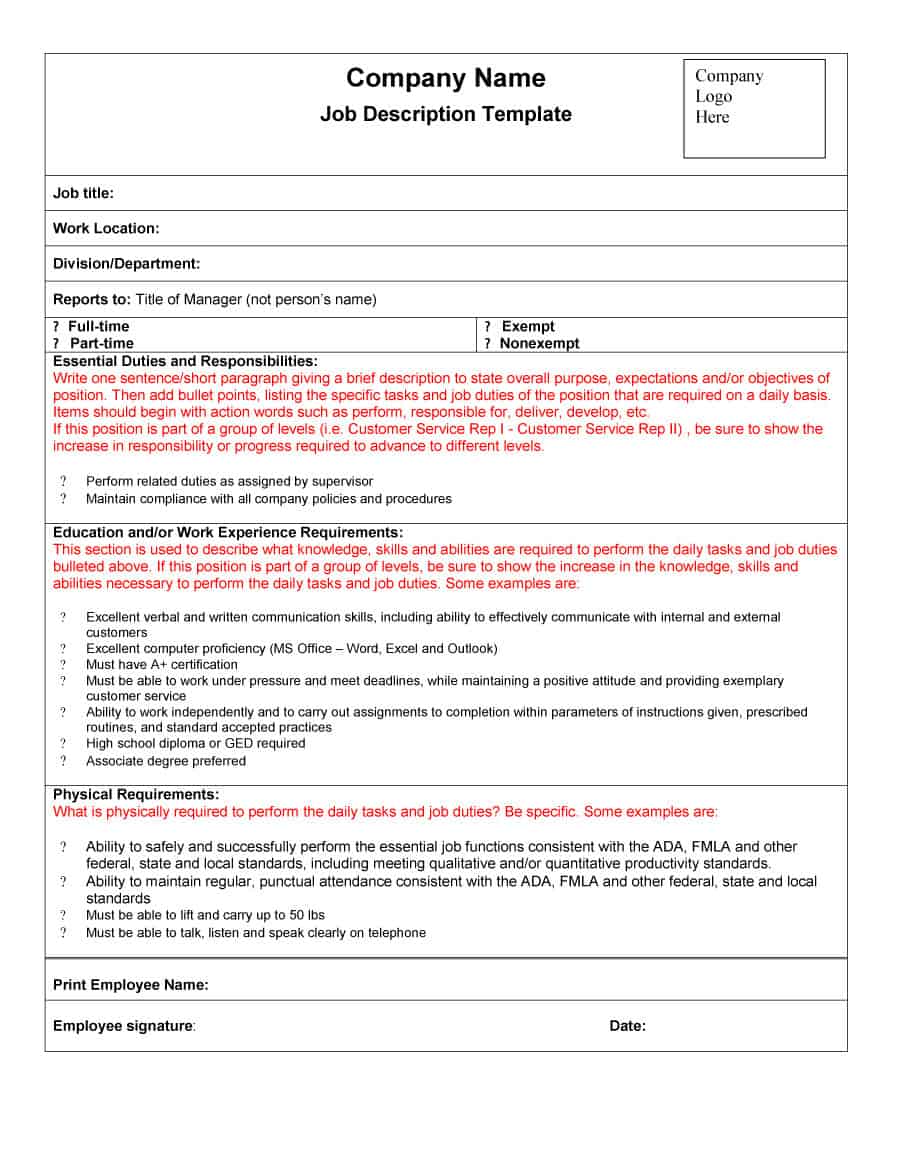
This template can be used to document the details of a specific job position within an organization. It provides a structured starting point for defining duties, qualifications, skills, and reporting responsibilities.
It can be adapted for entry-level, professional, supervisory, and management roles.
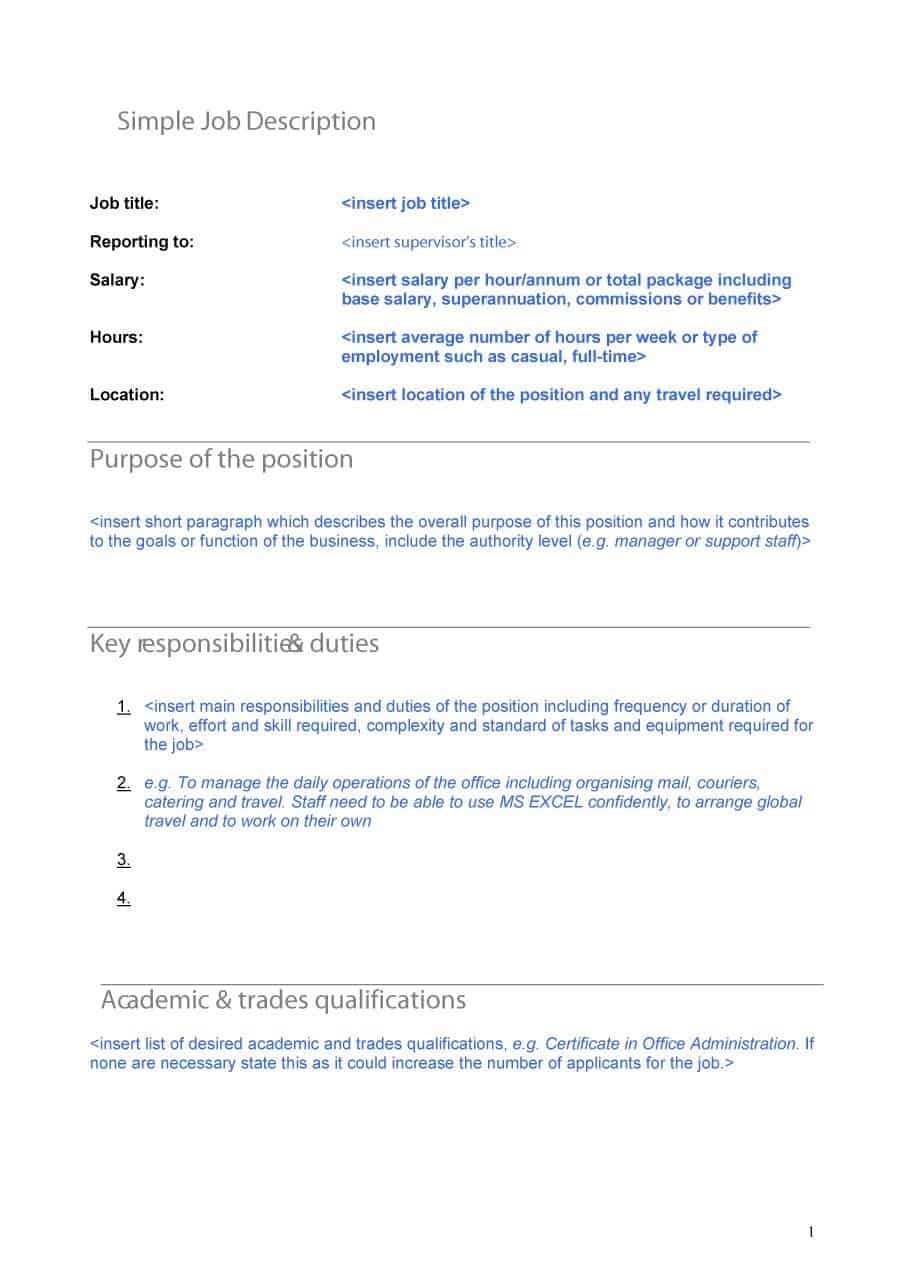
This sample template provides a reference for organizing information about an open or existing position.
Employers can replace the example information with details relevant to their own organization and job requirements.
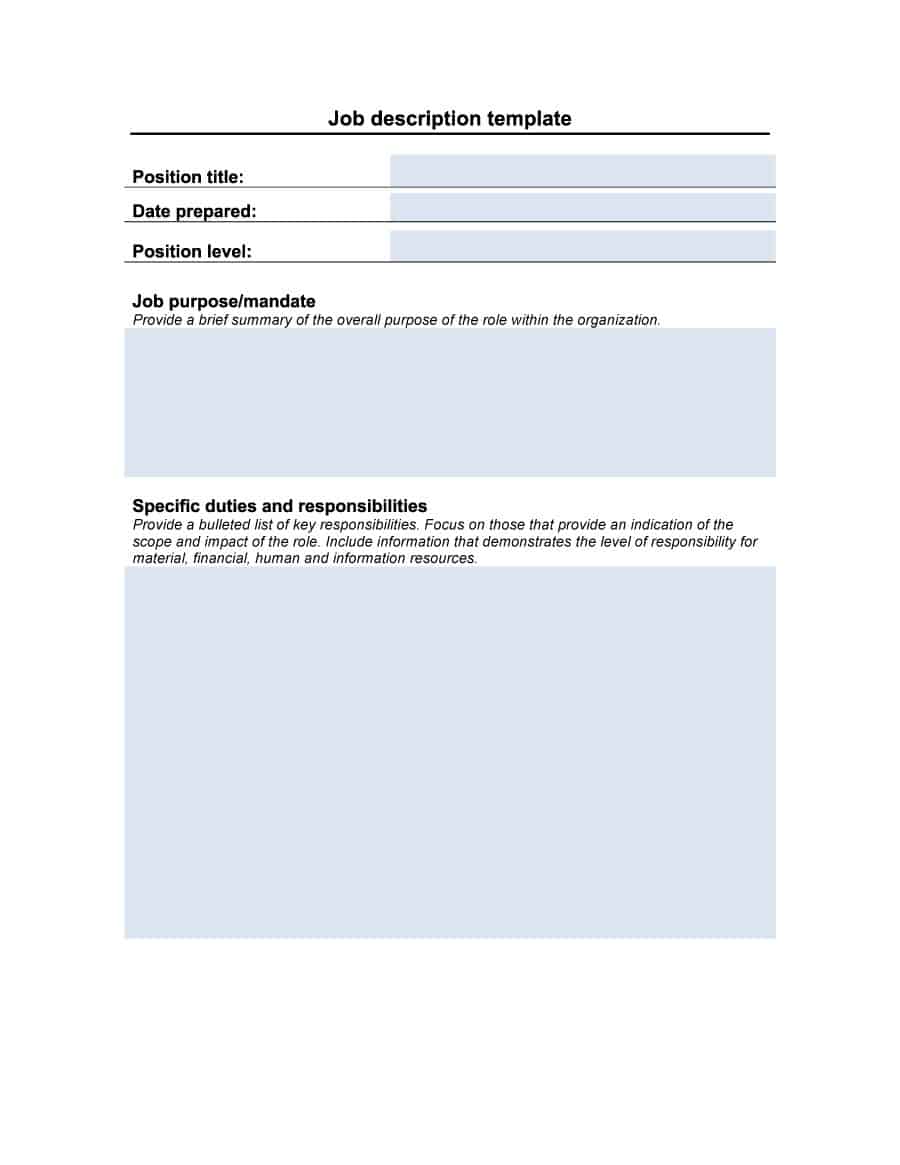
This example illustrates a structured approach to documenting a position. It can help employers create clearer descriptions for recruitment and internal role management.
The example should be customized so that all responsibilities and qualifications accurately match the actual position.
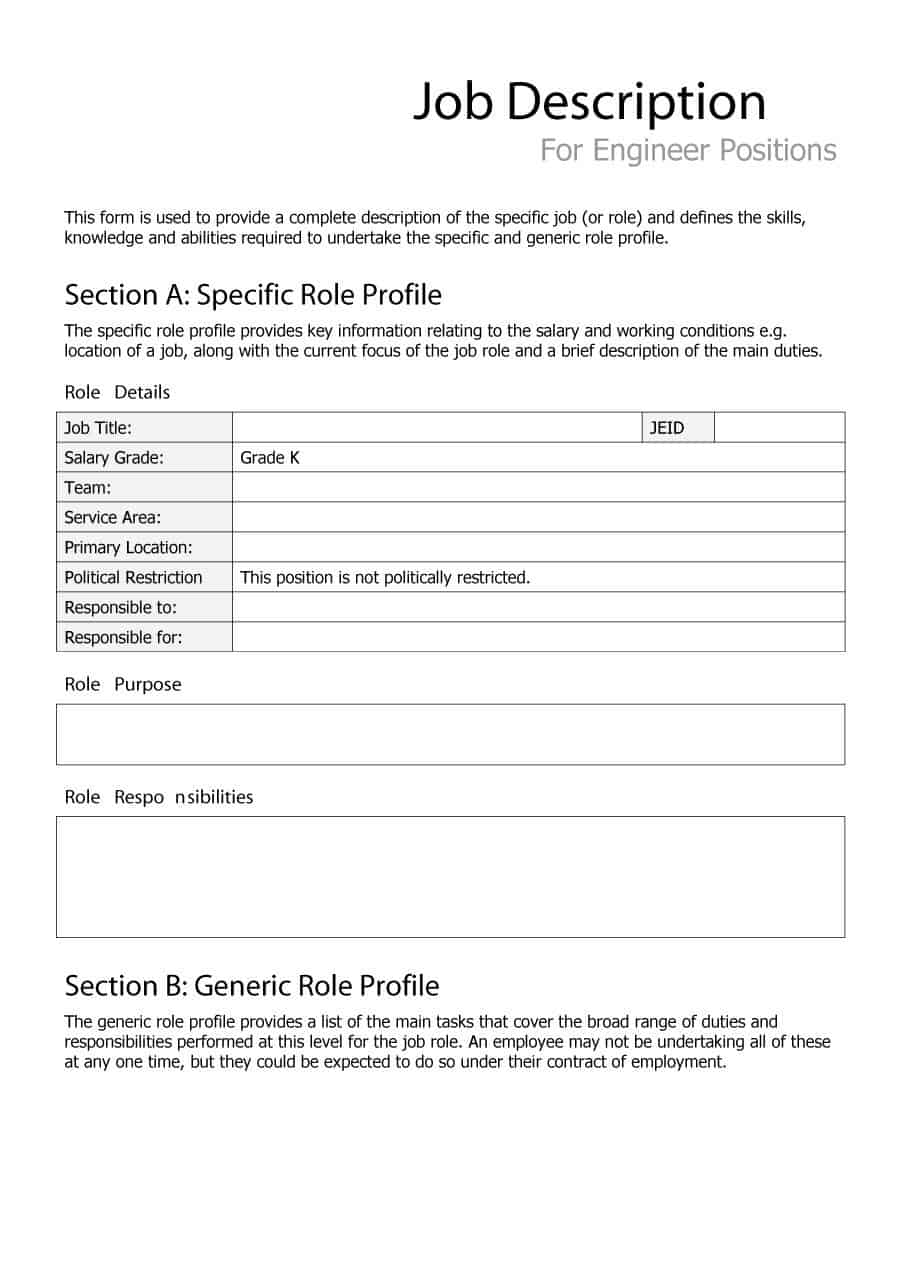
This template provides a job description format that can be edited and printed for use in HR or recruitment processes.
A printable document can be useful for managers and HR teams who review position requirements during hiring or organizational planning.
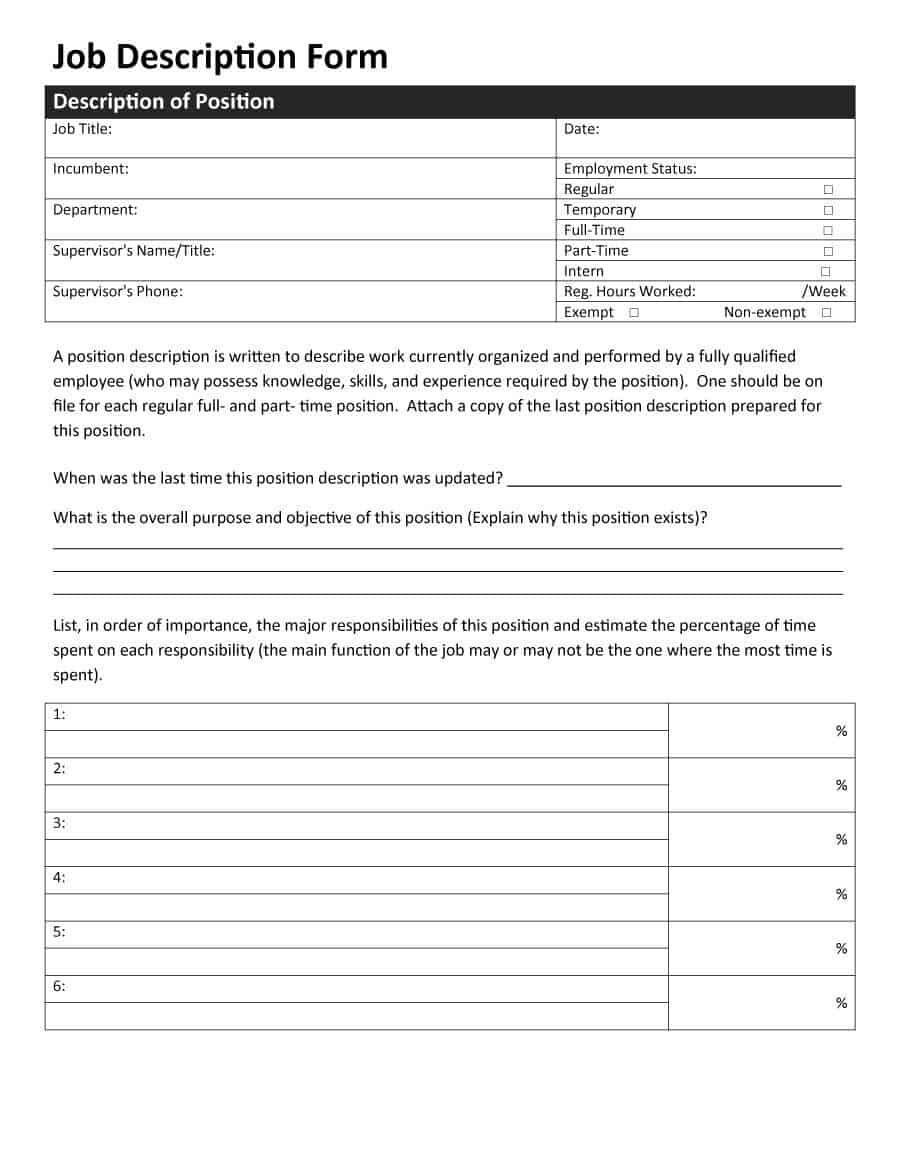
This Word template provides an editable document format for creating a job description.
It can be customized with the job title, position summary, responsibilities, qualifications, skills, department, and reporting information.
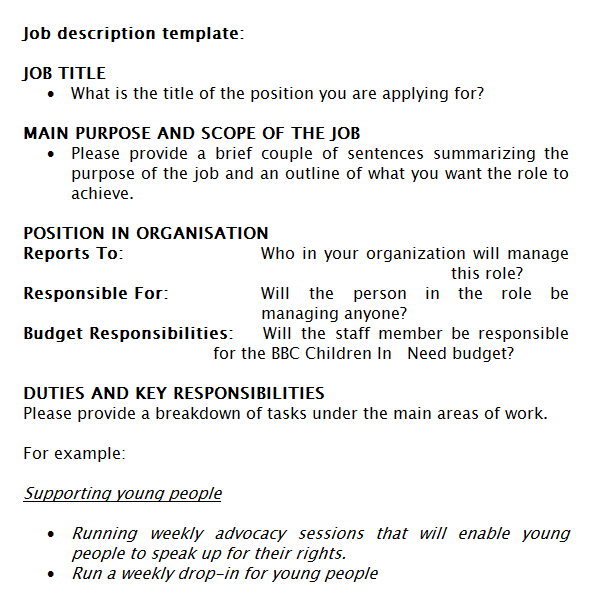
Frequently Asked Questions
What is a job description?
A job description is a document that explains the duties, responsibilities, qualifications, skills, reporting relationship, and expectations associated with a particular position.
What should a job description include?
A job description commonly includes the job title, position summary, responsibilities, qualifications, required skills, reporting relationship, location, employment type, and other relevant information.
Can I use a job description template in Word?
Yes. A Word template provides an editable structure that can be customized for different positions and departments.
What is the difference between a job description and a job posting?
A job description explains the position in detail, while a job posting is generally a public advertisement designed to attract applicants.
Why are job descriptions important?
They help employers define responsibilities and qualifications and help candidates understand whether a position matches their skills and expectations.
Should a job description include salary?
Salary information can be included when appropriate and required or preferred by the employer or applicable law. Requirements around pay transparency vary by location.
How long should a job description be?
There is no universal ideal length. It should be long enough to explain the role clearly without including unnecessary details.
Should job descriptions be updated?
Yes. Review them whenever responsibilities, qualifications, reporting relationships, working arrangements, or organizational needs change.
Can one template be used for different jobs?
Yes. A general job description template can be reused, but the responsibilities, qualifications, skills, and other role-specific information should be customized for each position.


You must be logged in to post a comment.