

Start with the daily journal if you want a quick record of meals and snacks. Choose the weekly diary for a one-page overview, the calorie and macro tracker for quantities, or the food-and-mood journal if you want room for context. The meal planner and grocery list is for deciding what to buy and cook ahead of time.
Food journal templates for daily meals, macros, and food-and-mood notes
Compare 5 free downloads by format.
| Resource | Format | Download |
|---|---|---|
| Daily Food Journal Template | Word | Download Daily Food Journal Template |
| Weekly Food Diary Template | Word | Download Weekly Food Diary Template |
| Calorie & Macro Tracker Template | Excel | Download Calorie & Macro Tracker Template |
| Food and Mood Journal Template | Word | Download Food and Mood Journal Template |
| Weekly Meal Planner & Grocery List | Excel | Download Weekly Meal Planner & Grocery List |
For the next step, compare menu planner templates and grocery list templates.
Try a three-day record
Write down the meal and time soon after you eat. If you’re tracking portions, use the same unit across entries. If you’re tracking how you feel, note the time and what else was happening that day. At the end of three days, decide which fields were worth keeping.
What Is a Food Journal?
A food journal, also called a food diary or food log, is a record of what you eat and drink, when and how much. Many people also note hunger levels, mood, water intake, sleep or how they felt after eating. Keeping a journal for a while can reveal eating patterns, help with meal planning and support goals such as eating more vegetables or managing portions. A food journal template gives you a ready-made page, so logging takes only a minute or two at each meal.
Advantages of food journal template
Food journal can be a small booklet or printed piece of paper allowing you to write down food plans and best eating stuff for your health that you should eat during a particular time period just like a week or month. Since food journal provides you a way to record all foods and recipes for the week, you can keep track of your foods in an organized manner as well as performance towards weight loss goals. Many fitness trainer and gym instructors prepare food diaries and journals for their clients to suggest them better foods and diets.
Significance of making and sticking with a food diary or journal goes beyond just the record of food an individual person or whole family ate because it helps us a lot to maintain a balanced diet recommended for good health and fitness. Whether you are working on weight loss goals or simply want to stay fit and healthy, our food journal template could be a good starting point for you to construct an appropriate food journal for the whole family or for yourself. It has sufficient space to add up personal food and diet details easily.
Free Food Journal Templates in Word and Excel
Download five free templates, three printable Word pages and two Excel trackers:
- Daily Food Journal Template: Word (.docx), 1 page.
- Weekly Food Diary Template: Word (.docx), 1 page.
- Calorie & Macro Tracker Template: Excel (.xlsx), 2 worksheets, with built-in formulas that calculate automatically.
- Food and Mood Journal Template: Word (.docx), 1 page.
- Weekly Meal Planner & Grocery List: Excel (.xlsx), 1 worksheet, with built-in formulas that calculate automatically.
Use the Word pages if you prefer writing by hand, or the Excel tracker if you want calories and macronutrients totaled automatically. The weekly meal planner helps you plan ahead and builds a grocery list with a cost total.
What to Record in a Food Journal
- Date and time of each meal or snack.
- What you ate and drank, including sauces, snacks and drinks.
- Portion size or servings.
- Calories or macronutrients, if you are tracking them.
- Water intake.
- Hunger and fullness before and after eating.
- Mood, energy and physical feelings.
- Where you ate and who with, if it helps spot habits.
- Sleep and activity notes.
How to Keep a Food Journal
Record food as soon as possible after eating, because details are easy to forget by the evening. Be honest and specific: “two slices of whole-grain toast with butter” is more useful than “toast.” Estimating portions is fine; measuring cups or a kitchen scale can help at first.
After a week or two, review your entries. Look for patterns such as skipped breakfasts, late-night snacking, low water intake or links between certain foods and your mood or energy. Choose one small change to try, then keep logging to see how it goes.
Types of Food Journals
- Daily food journal: a detailed page for each day.
- Weekly food diary: a full week on one page for a quick overview.
- Calorie and macro tracker: totals calories, protein, carbs and fat.
- Food and mood journal: focuses on emotions and mindful eating.
- Meal planner: plans meals ahead with a grocery list.
Tips for Sticking With It
- Keep the journal where you eat, or the file open on your phone or computer.
- Log weekends and special occasions too.
- Do not judge entries; the goal is awareness.
- Pair journaling with meal planning to make healthier choices easier.
Note: this is general information, not medical or nutrition advice. If you have a health condition, an eating disorder history or specific dietary needs, talk to your doctor or a registered dietitian before changing your diet.
Download Free Food Journal Templates Here
Download these original food journal templates for Word and Excel. Print the journals or track calories and macros automatically in Excel.
Daily Food Journal Template (Word)
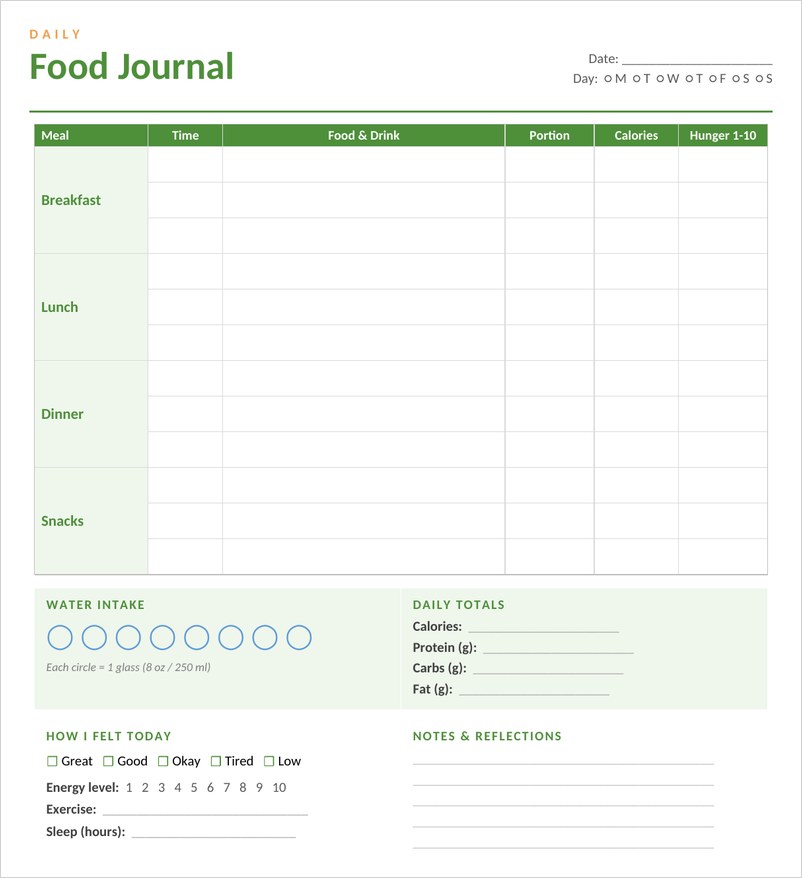
A printable daily food journal page to log meals, time, portions, calories and hunger, plus a water tracker, daily totals, mood, sleep and notes.
Weekly Food Diary Template (Word)
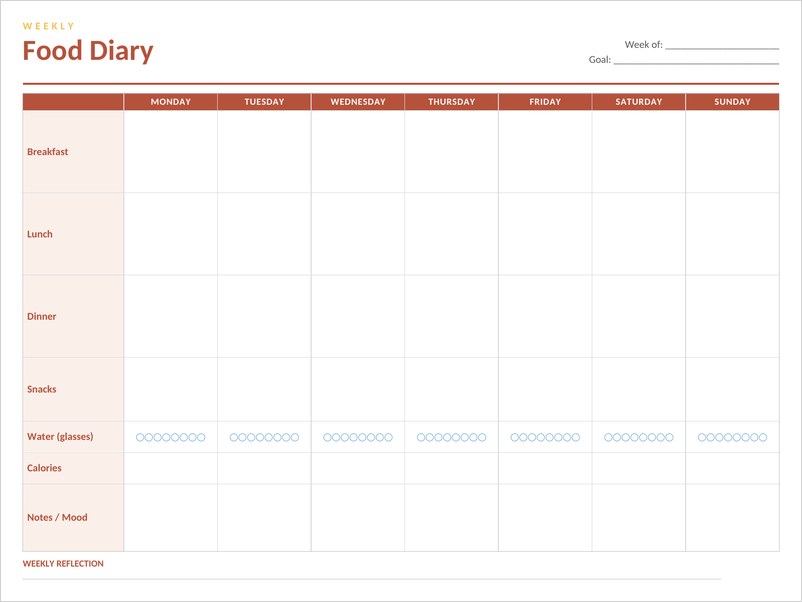
A one-page weekly food diary in landscape layout with columns for each day, rows for every meal and snack, water circles, calories and notes.
Calorie & Macro Tracker Template (Excel)
An Excel food log that multiplies servings by calories, protein, carbs and fat, then summarizes each day against your goals with progress bars.

Food and Mood Journal Template (Word)
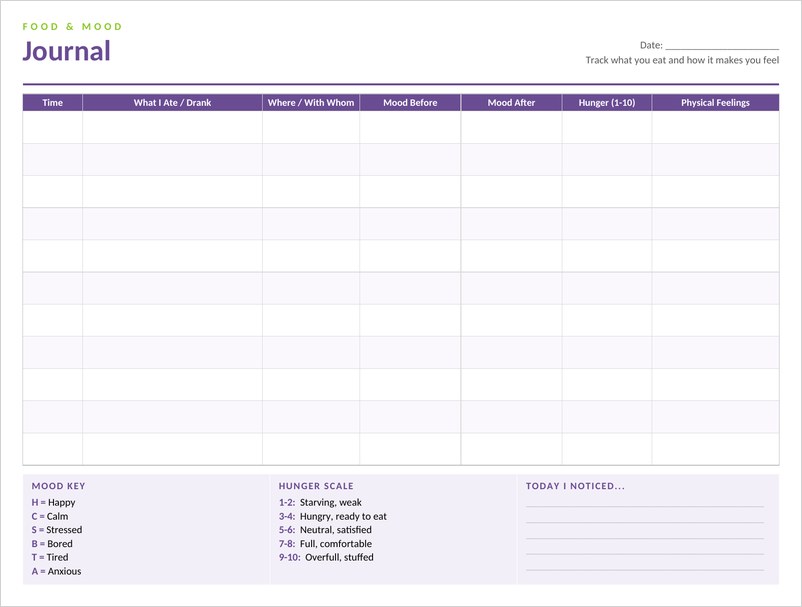
A food and mood journal for mindful eating that records what you ate, mood before and after, hunger level and physical feelings.
Weekly Meal Planner & Grocery List (Excel)
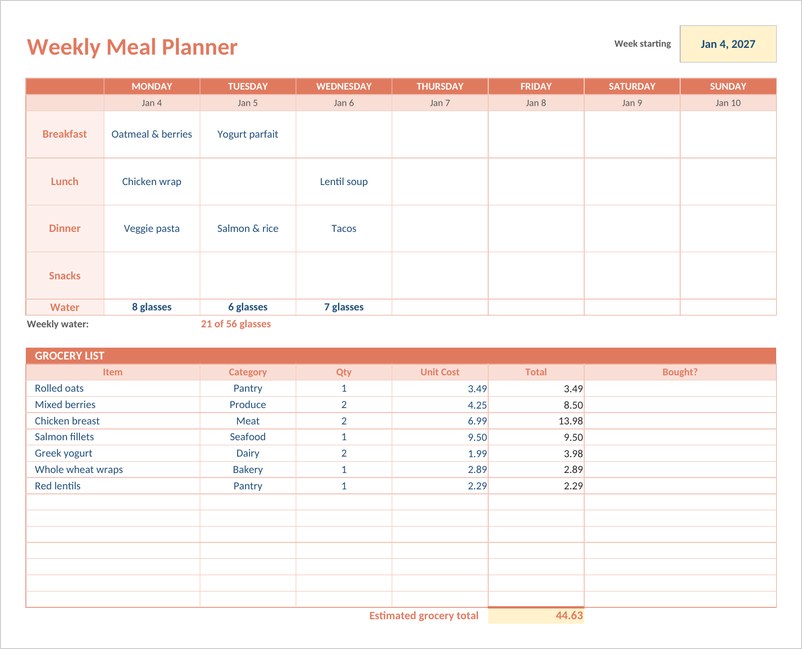
A weekly meal planner for Excel with automatic dates, meals for each day, a water log and a grocery list that totals your shopping cost.
Frequently Asked Questions
What should I write in a food journal?
Record what you eat and drink, the time, portion size and, if useful, calories, water, hunger, mood and sleep.
How long should I keep a food journal?
Even a week or two can reveal patterns. Some people keep logging longer while working toward a specific goal.
Can I track calories and macros in Excel?
Yes. The calorie and macro tracker multiplies servings by calories, protein, carbs and fat and summarizes each day against your goals.
What is a food and mood journal?
It records what you ate alongside your mood, hunger and physical feelings, to help you notice emotional or mindful eating patterns.
Is a food diary the same as a food journal?
Yes, the terms are used interchangeably for a record of what you eat and drink.
Do I need to record calories in a food journal?
No. Use the daily journal or weekly diary if meals and notes are enough for your purpose. The calorie and macro sheet is available when you specifically want to record those amounts.


You must be logged in to post a comment.